How to Become a PHP Developer: A Practical Roadmap
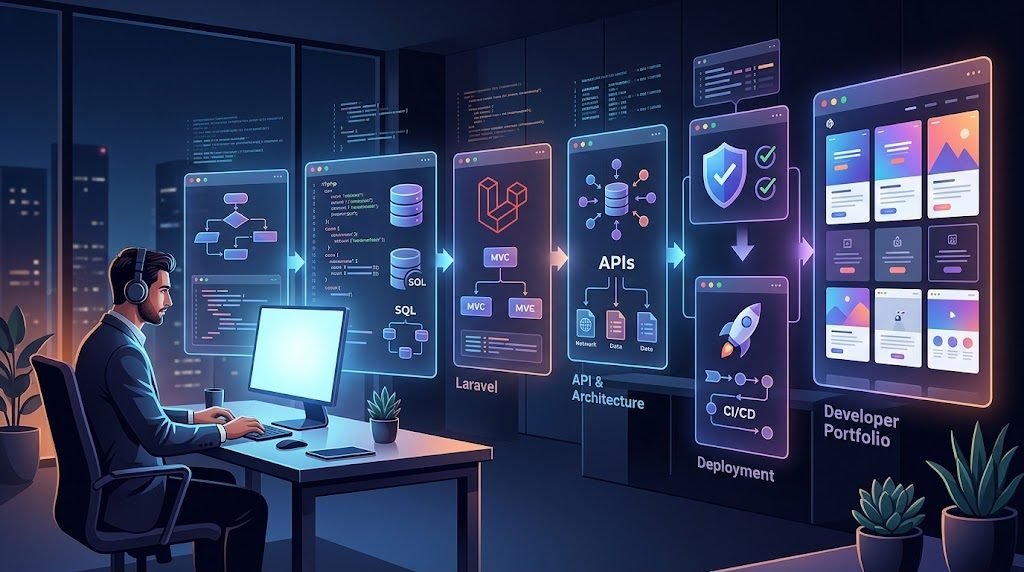
How to Become a PHP Developer: A Practical Roadmap
If you are interested in web development and want to learn how websites and web applications work behind the scenes, becoming a PHP developer can be a practical career path.
Learning PHP is not only about memorising programming syntax. A professional PHP developer needs to understand programming fundamentals, databases, web development, security, APIs, debugging, version control, and how different parts of an application work together.
The good news is that you do not need to learn everything at once. A structured learning path can help you move from basic programming concepts to building complete PHP and Laravel applications.
What Does a PHP Developer Do?
Before learning PHP, it helps to understand the type of work you are preparing to do.
A PHP developer may build and maintain websites, web applications, backend systems, APIs, dashboards, database-driven applications, and custom business software.
Depending on the project, a PHP developer may work with:
- PHP and Laravel
- HTML and CSS
- JavaScript
- SQL databases
- REST APIs
- Authentication systems
- Git and version control
- Hosting and deployment
- Security and application maintenance
If you are new to the term, read What Does PHP Developer Mean? for a simple explanation of the role.
Step 1: Learn Basic Programming Concepts
One of the biggest mistakes beginners make is trying to learn a framework before understanding programming fundamentals.
Start by learning concepts that apply to almost every programming language.
- Variables
- Data types
- Conditions
- Loops
- Functions
- Arrays
- Objects and classes
- Error handling
- Basic problem solving
Once you understand these ideas, learning PHP becomes easier because you are learning a new language rather than trying to understand programming from zero.
Step 2: Learn PHP Fundamentals
After learning basic programming, move into PHP itself.
Important PHP topics include:
- PHP syntax
- Variables and constants
- Strings and numbers
- Arrays
- Conditional statements
- Loops
- Functions
- Form handling
- Sessions and cookies
- File handling
- Object-oriented programming
- Error and exception handling
Do not rush through these topics. A strong understanding of PHP fundamentals will make advanced framework development much easier later.
Step 3: Learn HTML and CSS
PHP is primarily used for server-side development, but PHP developers still need to understand how the browser side of a website works.
Learn enough HTML and CSS to build and understand complete web pages.
Focus on:
- HTML document structure
- Semantic HTML
- Forms
- Links and navigation
- CSS layout
- Responsive design
- Mobile-friendly interfaces
You do not need to become a specialist frontend designer to begin PHP development, but understanding frontend fundamentals will make you a more capable web developer.
Step 4: Learn SQL and Databases
Many PHP applications are built around databases. A website may need to store users, products, articles, orders, bookings, settings, or other business data.
This makes database knowledge one of the most important skills for a PHP developer.
Start with:
- Tables and columns
- Primary keys
- Relationships
- SELECT queries
- INSERT, UPDATE and DELETE
- Filtering and sorting
- Joins
- Indexes
- Database security
Understanding SQL directly will also help you understand what frameworks and ORMs are doing behind the scenes.
Step 5: Build Small PHP Projects
At this stage, start building projects rather than only watching tutorials.
Good beginner projects can include:
- Contact form
- Simple blog
- To-do application
- Login and registration system
- Simple CRUD application
- Product management system
- Small admin dashboard
A project should give you an opportunity to write code, make mistakes, debug problems, work with a database, and improve the application over time.
Step 6: Learn Git and Version Control
Once you begin working on real projects, version control becomes extremely useful.
Git allows developers to track changes, work safely on new features, return to earlier versions, and collaborate with other developers.
Learn basic Git operations such as:
- git init
- git clone
- git status
- git add
- git commit
- git pull
- git push
- Branches and merges
You do not need to master every advanced Git feature before building projects. Start with the fundamentals and use Git regularly.
Step 7: Learn Object-Oriented PHP
As your applications become larger, procedural code alone can become difficult to organise and maintain.
Object-oriented programming helps developers structure applications using classes, objects, properties, methods, interfaces, inheritance, and other programming concepts.
Important concepts include:
- Classes and objects
- Constructors
- Properties and methods
- Encapsulation
- Inheritance
- Interfaces
- Traits
- Namespaces
Step 8: Learn Laravel
After understanding PHP fundamentals, learning a framework such as Laravel can help you build larger applications using a more structured development approach.
Laravel provides tools for common web application requirements such as routing, controllers, database access, validation, authentication, queues, caching, APIs, and application organisation.
A good Laravel learning path can include:
- Routing
- Controllers
- Blade templates
- Models and Eloquent
- Migrations
- Validation
- Authentication
- Middleware
- Mail and notifications
- Queues and jobs
- APIs
- Testing
If you want to understand how to select the right framework for a project, read How to Choose the Right Web Development Framework in 2026 .
Step 9: Learn APIs
Modern applications rarely work completely on their own. Websites and applications often communicate with payment systems, mobile apps, email services, analytics platforms, maps, authentication providers, and other systems.
Learning how APIs work will therefore make you much more capable as a PHP developer.
Understand concepts such as:
- HTTP requests
- GET, POST, PUT and DELETE
- JSON
- Authentication
- API validation
- Status codes
- REST APIs
Step 10: Learn Web Security
Security should be part of your development process from the beginning.
A developer should understand common web security problems and how to reduce the risk of exposing application data or user accounts.
Important areas include:
- Input validation
- Authentication
- Authorization
- Password security
- Session security
- SQL injection prevention
- Cross-site scripting protection
- Cross-site request forgery protection
- Secure dependency management
Step 11: Learn Debugging and Testing
Professional development involves much more than writing new features. Developers spend a significant amount of time understanding errors, investigating unexpected behaviour, and improving existing code.
Learn how to read error messages, inspect logs, reproduce bugs, test different scenarios, and verify that a change has not broken another part of the application.
Testing can gradually become part of your workflow as your projects become more complex.
Step 12: Learn Hosting and Deployment
Building an application locally is only one part of web development. Eventually you need to make the application available on a real server.
Learn the basics of:
- Domains
- DNS
- Web servers
- PHP versions
- Environment variables
- Database configuration
- SSL certificates
- File permissions
- Application deployment
- Backups
Understanding deployment also helps you troubleshoot problems that do not appear during local development.
Step 13: Build Real-World Projects
Once you understand the basics, focus on projects that simulate real business requirements.
For example, build:
- Business websites
- Booking systems
- Customer dashboards
- Property listing systems
- Inventory systems
- Content management systems
- Internal business software
- API-based applications
Real projects force you to think about requirements, database structure, user experience, security, deployment, maintenance, and edge cases.
Step 14: Build a PHP Developer Portfolio
A portfolio is one of the most practical ways to demonstrate what you can build.
Instead of simply listing technologies, show actual projects and explain what you built.
A good portfolio project can include:
- Project description
- Your role
- Technologies used
- Main features
- Database or API functionality
- Challenges solved
- Live demo where possible
- Screenshots
You can view the LuqmanDev portfolio to see examples of websites, applications, and digital products.
How Long Does It Take to Become a PHP Developer?
There is no single timeline that applies to everyone.
Someone with previous programming experience may progress faster than a complete beginner. Your learning speed also depends on how consistently you practise and how much time you spend building projects.
Instead of focusing only on a number of months, focus on whether you can independently build and maintain useful applications.
For example, you should gradually become comfortable with:
- Writing PHP code
- Working with databases
- Building forms and authentication
- Creating APIs
- Using Laravel
- Debugging applications
- Deploying applications
- Maintaining existing projects
Common Mistakes Beginners Should Avoid
Learning web development can become unnecessarily difficult when beginners focus on the wrong things.
Trying to Learn Everything at Once
PHP, Laravel, JavaScript, databases, Docker, cloud platforms, APIs, testing, and frontend frameworks can quickly become overwhelming.
Learn one layer at a time and build projects as you progress.
Watching Tutorials Without Building
Tutorials can explain concepts, but practical development requires you to solve problems independently.
After learning a concept, try using it in your own project.
Starting With a Framework Too Early
Laravel can make development more productive, but understanding PHP first makes framework concepts much easier to understand.
Ignoring Databases
Many real-world PHP applications depend heavily on data. Database knowledge should therefore be treated as a core development skill rather than an optional extra.
Ignoring Security
Security should not be something you study only after building your first application. Basic security practices should be part of your normal development process.
PHP Developer Learning Roadmap
A simple roadmap can look like this:
- Programming fundamentals
- PHP basics
- HTML and CSS
- SQL and databases
- Object-oriented PHP
- Git and version control
- Small PHP projects
- Laravel
- APIs
- Security
- Testing and debugging
- Deployment
- Real-world applications
- Professional portfolio
The roadmap does not have to be completed in a perfectly linear order. Development skills often grow together as you work on larger and more realistic projects.
What Kind of Jobs Can a PHP Developer Do?
PHP skills can lead to different types of development work depending on experience and specialization.
Examples include:
- PHP Developer
- Backend PHP Developer
- Full Stack PHP Developer
- Laravel Developer
- Web Application Developer
- Backend Web Developer
- PHP Maintenance Developer
The exact responsibilities behind these titles can vary between companies, so it is useful to look beyond the job title and examine the actual technical requirements.
Can You Become a PHP Developer Without a Computer Science Degree?
A formal computer science degree is not the only way to learn web development. Many developers build their skills through self-study, practical projects, professional experience, courses, documentation, and continuous practice.
What matters in practical development is whether you can understand problems, design solutions, write maintainable code, work with real systems, and continue learning as technologies change.
When Are You Ready to Call Yourself a PHP Developer?
There is no official single test that determines when someone becomes a PHP developer.
A useful practical milestone is being able to independently build and maintain a real application rather than only following tutorials.
You should gradually be able to:
- Understand requirements
- Design a basic application structure
- Work with PHP and databases
- Build user-facing functionality
- Create APIs
- Handle authentication
- Debug problems
- Apply basic security practices
- Deploy an application
- Maintain and improve the project
At that point, you are moving beyond learning syntax and beginning to work like a professional developer.
Explore LuqmanDev
If you are interested in PHP, Laravel, web applications, WordPress, mobile applications, or SEO, you can explore LuqmanDev services to see the types of digital projects that can be developed.
You can also view the LuqmanDev portfolio to explore real websites, applications, and digital products.
If you are planning a website or custom application, contact LuqmanDev to discuss your requirements and define a practical project scope.
Conclusion
Learning how to become a PHP developer is a gradual process. Start with programming fundamentals, learn PHP properly, understand databases and web development, build real projects, and then move into Laravel, APIs, security, testing, and deployment.
The most valuable part of the journey is not simply collecting technologies. It is learning how to solve real problems and turn business requirements into reliable software.
Build projects, learn from your mistakes, maintain your applications, and continuously improve your understanding of web development. Over time, these practical skills can become the foundation of a professional PHP development career.
Interested in PHP or Laravel development?
Have a website, web application, or custom software idea?